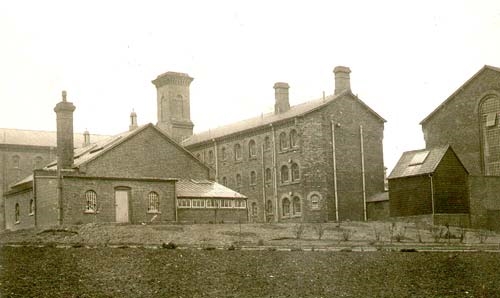
 |
“Reproduced
from the “Our Warwickshire” website © Warwickshire County Record
Office
(reference CR 2902/84).
Warwick Prison, to where the Revd Richard Enraght was taken under arrest on the 27 November 1880.
(Prison demolished in 1934) |
The following transcript is from the Sheffield Daily Telegraph 29 November 1880:-THE RITUALISTIC CONTROVERSY
ANOTHER CLERGYMAN ARRESTED
EXTRAORDINARY SCENE
The long-pending arrest of the
Rev. R. W. Enraght, Vicar of Holy Trinity, Bordesley, took place on
Saturday. Since the commitment of the Rev. Gentleman his arrest has
been almost hourly expected, and the delay which has taken place has
naturally excited considerable speculation in the district.
On Friday night the complainant’s
solicitor wrote to Mr. Roper, the Sheriff’s officer for the Borough
of Birmingham requesting that he would serve it at once.
On Saturday morning intelligence
was received by Mr. Enraght that the writ would be brought over by
the quarter past twelve train from Warwick. On this information being
received, the following notice was posted on the board near the
church railings – “Your Vicar will be arrested this afternoon at
1.30. Train leaves for Warwick Gaol at 2.4.”
A little crowd soon congregated on
this announcement being made, and it is not a little remarkable that
one of the first passer by to glance at the notice was Canon
Wilkinson, who chanced to be walking along Camp Hill. As the hour for
the arrest drew nigh, the crowd outside the church gradually
increased, and, the original object of exhibiting the notice having
been served, it was taken down.
Between twelve and one o’clock a
number of Mr. Enraght’s most intimate friends arrived at the house
to witness the departure for Warwick. Among the visitors were the
Revs. C. Boddington, J. S. Pollock, W. Elwin, L. Taylor, G. F. B.
Cross, Messrs. Clay and Harris (churchwardens).
Mr. Roper, the sheriff’s
officer, arrived about one o’clock with the writ, ans was
courteously ushered into the drawing-room, where he took up his
stand until Mr. Enraght was in readiness to accompany him. The few
minutes that remained passed away without any incident of note, Mr
Enraght chatting pleasantly with his friends without appearing in the
least degree disconcerted by the presence of the officer of the law.
About twenty minutes to two Mr. Enraght having previously retired for
a few minutes to complete his preparations, returned, wearing his
cassock, and advancing up to the sheriff’s officer, announced his
readiness to accompany him.
The sheriff’s officer, producing
the writ, replied ; Mr. Enraght I have a warrant here to lodge your
body in Warwick Gaol.
Mr. Enraght amidst the cheers of
his friends, delivered the following address protest :- I solemnly
protest in the name of God and of the Church of England against your
arresting me or interfering with me in any way under the authority
proceeding from the Court of Lord Penzance, whose jurisdiction over
me in spiritual matters I do not acknowledge.
The sheriff’s officer pleasantly
remarked that he must obey his instructions and take Mr. Enraght to
Warwick Gaol. Mr. Enraght of course had his remedy afterwards. Mr.
Harris, one of the churchwardens, addressing the sheriff’s office,
said ; “in my name, and in the name of my colleague, I most
emphatically protest against this arrest.”
The process of arrest having been
completed, Mr Enraght and his friends filed out of the room into the
churchyard, which was crowded, and there was another great concourse
outside. The sheriff’s officer was among the first to pass down the
churchyard, and he was enabled to reach the street unrecognised.
Immediately the Vicar appeared among the crowd there was a tremendous
cheer, accompanied by deep groans for a certain member of the
congregation who instituted the proceedings which now culminated in
the arrest.
A number of the congregation
pressed forward to shake hands with the Vicar, who must have felt
extremely gratified with his reception. On reaching the churchyard
gate the Vicar motioned to the crowd that he wished to address them,
and immediately there were cries of “Silence” and “Hats
off.”
The Rev. Gentleman spoke in a firm, clear voice, a few
words of exhortation and hope. The Doxology was then sung by the
crowd, amidst great excitement the Vicar and the Sheriff’s officer,
accompanied by the churchwardens, proceeded to Bordesley station,
where they left for Warwick by the 2.4 train.
Mr. Enraght, who had been hourly
expected during the morning, arrived at Warwick by the 2.50 train. He
was accompanied by about thirty friends, amongst them being his
churchwardens, Messrs. Harris and Clay, Rev. James Pollock, Rev. T.
L. Taylor, Curate of St Andrew’s Bordesley, Mr. Rowland Bagnall,
Mr. Playne, Mr. Farley, secretary to the Birmingham Branch of the
English Church Union ; Mr. Whitworth, secretary to Church of England
Working Men’s Society ; Mr. H. T. Ratcliffe, churchwarden of St
Alban’s ; Mr. Pearce, secretary Midland District Church Union, and
Messrs. Norman Perkins and Fairley, representing the congregation of
St. Nicholas, Tower Street.
The Rev. Gentleman was met at the
station by the Rev. Dr. Nicholson, of Christ Church, Leamington, with
whom he shook hands most cordially, remarking those around him, “We
are not Ritualists, but simply Churchmen.”
Mr. Enraght at his own desire,
proceeded on foot to Warwick Gaol, a distance of half a mile, and
upon reaching the prison exchanged a farewell with his friends
outside the gaol. He looked somewhat anxious, but appeared in
excellent spirits.
Just before entering the prison,
Mr. Enraght knelt upon the stones and received a blessing at the
hands of the Rev. Dr. Nicholson. A large crowd had meanwhile
assembled and cheered Mr. Enraght enthusiastically.
During Sunday several persons
called at the prison lodge and left their cards for the Rev.
Gentleman. Mr Enraght is said to be in excellent spirits. He is
imprisoned as a first-class misdemeanant.
The services at Holy Trinity were
yesterday conducted in the precise way adopted by Mr. Enraght and for
which he is now lying in Warwick Gaol. It is not intended to deviate
in the slightest degree from the pronounced Ritual services of the
imprisoned Vicar. At both morning and evening services the church was
densely crowded.
*******
 |
copyright
© PCC
of St Alban and St Patrick, Highgate, Birmingham.
From the Governor, H. M. Prison Warwick, 29th November 1880.
To:- Revd James Benson Pollock, St Alban the Martyr, Birmingham,
You
are allowed to visit The Rev. R. W. Enraght between 2 and 5 on any Monday, Wednesday and Friday.
Please
present this Order.
John M. Anderson, Governor. |
Mr John Anderson, the Governor of Warwick Prison, who was no High Churchman,
said of Fr Enraght to one of his visitors: "The sooner that gentleman is
out, sir, the better, for he is altogether in the wrong place". For
nearly two months he was kept in Warwick Prison, and during that time a
great meeting was held, when Birmingham Town Hall was filled from end to
end, and so many came from far and near to protest against the
imprisonment; the singing of the Church's one Foundation at the end
was something impressive and touching.
*******
 |
Image from the New Catholic World v.33 (1881)
The above noticed was posted on walls around the Parish of Holy Trinity, Bordesley |
The
following letter from Mr. W. Perrins (a Birmingham Jeweller) to the London Church Review, gives
an account of the arrest of the Revd. Richard Enraght on 27th November
1880 :-
SIR, Will
you kindly permit me to send you a short account of the wonderful
scenes that took place at the arrest of our dear friend Mr. R. W.
Enraght?
Mr. Dale
was taken to prison at night, when but few could see or hear about
it, but had we been able to choose our own time, we could scarcely
have chosen better. Though it was only known one hour before the
arrest, yet so earnest were his friends in their sympathy and
devotion that by the time the arrest took place, half-past one P.M.,
a vast crowd, numbering about two or three thousand persons,
assembled, who showed the deepest sympathy with the persecuted vicar.
I arrived
upon the scene a few minutes before the vicar left the house, and
such a scene I never saw before, and perhaps may never see such a one
again. Ladies, with tears in their eyes and quivering lips and
anxious faces, thronged around the door; and one gray-haired old man
I spoke to burst into tears and said, "Ah, Sir, this is
religious liberty in England." There were many working men of
the congregation, with their dirty, but sympathetic faces, who had
rushed from their work to bid a farewell to one they so loved and
venerated, and all looked as though each heart was full.
Before
leaving the house the vicar read a solemn protest against his arrest
(a copy of which and address I enclose), and then came out
accompanied by the Rev. J. Pollock and C. Bodington arm-in-arm,
several other clergymen and friends, including the two churchwardens,
bringing up the rear.
The vicar,
walking to his gate, paused on the step and indicated that he wished
to speak to the vast crowd, and then he gave the memorable address,
which those who heard will not in a hurry forget. The emotion of the
people was intense. We could hardly imagine we were in the nineteenth
century, for as we stood after the address to sing the doxology, it
seemed like the early Christians going to their martyrdom; but the
most touching part of all up to the present was at the close of the
singing. The assembly bared their heads, and those around knelt upon
the pavement while the vicar pronounced a most solemn benediction.
The prisoner then walked to the railway-station, followed by the vast
crowd, who cheered most lustily, occasionally giving a hearty groan
for "Perkins," etc., etc. During the whole of the
proceedings I did not see or hear one dissentient.
The vast
crowd of course could not get into the station, in fact very few, or
else many would doubtless have gone to Warwick with the prisoner. As
it was, about thirty friends went, including the Rev. J. Pollock and
the two churchwardens, who, to whose honour, be it said, never left
the prisoner till he arrived at the gate of the jail. Immediately we
left the train at Warwick the vicar was met by the Rev. Dr.
Nicholson, of Leamington, who took the prisoner by the arm and did
not leave his side until we reached the gate, walking all the way.
The road from the station is a rather lonely one, up and down hill,
and as we started upon it the vicar exclaimed, "We are not
Ritualists, but simple Churchmen."
I then
thought, for the first time, he looked lonely, but as though the
Divine eye was watching him in his trouble, the rainbow appeared in
its beauty, bidding him hope and trust in One who has said, "I
will not leave thee nor forsake thee," "Be thou faithful
unto death, and I will give thee a crown of life." The vicar's
friends had taken care that the luggage should be substantial, but
right willingly was it carried by those present, as though each was
anxious to do what he could for the one who was to be cast into a
prisoner's cell.
Before we
reached the Jail we were met by the Rev. S. Harris, of Leicester
Hospital, Warwick, who in an excited manner called for cheers for the
prisoner, remarking that "that was the reward of hard work and
faithful service, also an answer to the question why we could not get
more candidates for holy orders." As we drew near the prison
gate the vicar let down his cassock so that he might enter as a
Priest. At the gate he shook hands with us all, Dr. Nicholson saying,
"Let us give him the blessing before he enters," and there,
upon the damp stones, the prisoner knelt, and the white-haired
doctor, with uplifted hand, pronounced the most solemn benediction I
think I ever heard.
Our dear
friend then entered the prison-gates, his last words being "The
Lord be with you." We could not help responding, "And with
thy spirit."
So ended
the arrest of one of the best men who ever suffered for his Master,
and the impression it has left upon our minds seems to be
"disestablishment," for it is too great a price to pay for
the advantages of being united to the State.
W. PERRINS.
BIRCHFIELDS, BIRMINGHAM,
Feast of St. Andrew, 1880.
*******
 |
(Illustration from the Birmingham Daily Post 28th November 1880)
Fr Richard
Enraght entering Warwick Prison in chains, handing a bag entitled,
"Paraphernalia of Ritualism" to his Curate, the Revd Warwick Elwin
(later
to become the Vicar of St. Andrew the Apostle, Worthing, Sussex.)
On the floor of the prison there are rolled up letters, entitled 'Congregation Sympathies'
(Although not factually correct, the artist has added the names of the Revd T. P. Dale and Revd F. Green above the other cell
doors, under the heading of 'Religious Liberty'. Revd Dale was actually sent to Holloway Prison in London and the Revd Green to Lancaster Castle Prison) |
The following text is from the What is the Use ? poster affixed to the prison wall in the above Birmingham Daily Post illustration :-
What is the Use ?
The prosecutions must prove futile, because the doctrines aimed at, may
be legally taught by ministers of the Church of England. It has been
decided that baptismal regeneration may be lawfully taught; it has also
been decided that a real presence in the Sacrament of the Lord’s Supper
may also be lawfully taught. As to the assertion of a priesthood, the
Prayer Book is full of it; and the Low Churchmen are conscious of the
difficulty of explaining it away. If then, the doctrine remain and must
remain --- for no one seriously propose to expunge it by legal process
--- of what use is it to go on prosecuting and imprisoning clergymen who
insist upon the use of symbols as a means of enforcing a doctrine which they may preach without legal hindrance, from one end of the year to the other
*******
Fr.
Enraght’s imprisonment became widely known in the USA. On the 19th
December 1880, a sermon was preached in St. Ignatius Church in New York, by the Revd Dr.
Ewer, S.T.D
on the subject of 'The Imprisonment of English Priests for Conscience Sake', he praised the English priests stand, as "simply a
determined resistance to a violation of Magna Charta, and was proud to
make common cause with them, so far as is possible, from this distance,
and feeling that when one member of the Catholic Church suffers, all the
members suffer with him". the text of this sermon was printed in full
in the New York Herald and New York Tribune the following morning.
(There were also four other priests who served prison sentences in
England:- Arthur Tooth, T. Pelham Dale, Sidney Faithorn Green and James
Bell Cox).
While
in prison Fr Enraght received a letter of support from the Conference
of the Confraternity of the Blessed Sacrament in the USA, "to express
the sympathy of the Conference for Fr R. W. Enraght in his incarceration
for conscience’s sake."
*******
The Revd Prof. Edward Bouverie Pusey wrote a letter to the editor of The Times defending
both Fr Richard Enraght and Fr Alexander Heriot Mackonochie saying, "they have not been struggling for themselves but for their people. The
Ritualists do not ask to interfere with devotion of others ….only to be
allowed, in their worship of God, to use a Ritual which a few years ago
no one disputed". [34]
*******
Over the
Christmas period of his imprisonment Fr Enraght also received many
letters of support and goodwill from his own and former parishioners
around the Country as well as Christmas Cards from children in Bordesley [35]
*******
A Mr. G. Wakelin’s recollections of the events surrounding Fr Enraght’s imprisonment where such:-
“To
describe his leaving the vicarage where his people had ever found in
himself and Mrs. Enraght helpers in all times of need and trouble, is
beyond my power; most pathetic and touching was the going to Warwick
Prison. His friends, and even those who had to carry out the sentence,
were far more touched and overcome than was the vicar himself, who went
through it with a calm fixed patience, with thorough cheerfulness and
resignation".
*******
 |
The text above, is from an 1880 protest poster against the Public Worship Regulation Act [58]
This poster was attached to walls and hoardings around England, to
express the
continuing public opposition to the Public Worship
Regulation Act.
A copy of this poster was also fixed to a wall close to
Lambeth Palace,
which greatly annoyed Archbishop Tait of Canterbury. |
*******
SEE:- 'High Church & Low Church 1883' page and Revd Richard Enraght 1874-1883 Bordesley page
*******
*N.B. because of his active
opposition to the Conservative Government's Public Worship Regulation Act., the Revd Richard Enraght, his wife Dorothea, and their six
young children were evicted at Easter 1883, from their Bordesley Vicarage by order of the Lord Bishop of Worcester.
The Enraght Family with the help of the Church Union,
moved to Brighton in Sussex, where Fr Enraght could continue his
ministry helping his former vicar, Fr Wagner of St Paul's Brighton.
See the 'My Ordinations Oaths' page, written by Revd Richard Enraght while in Warwick Prison in December 1880.
*******
Transcriptions by D. Sharp 2025


