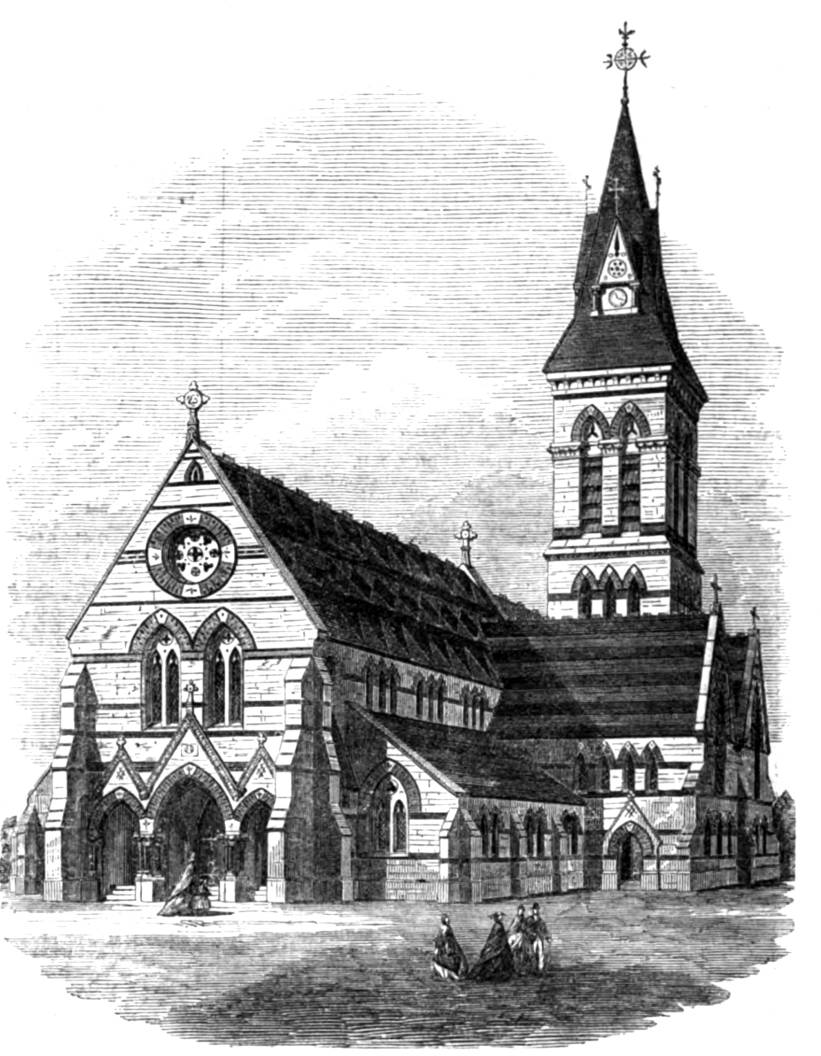
 |
| Image Credit the Hathi Trust Digital Library and The University of Michigan Library. St Michael & All Angels, Bromley by Bow, Poplar, London. (In the 1980's, this church was converted into flats and is now known as St Michael's Court) |
Fr Enraght continued the next 9 years of his ministry in London after leaving Brighton. Bromley by Bow was reported to be 'the poorest Parish' in the East End of London:-
In December 1884 Fr Enraght was licensed to the curacy of St Michael’s
Bromley by Bow, Poplar (Tower Hamlets) by the Bishop of London.
A year later in December 1885,
there were calls from the Church
Association for the
Bishop of London (Dr Frederick Temple) to revoke the Curacy License
of Fr Enraght at St Michael & All Angels, the
Bishop refused to use the Public
Worship Regulation Act
against Fr Enraght.
Dr Temple saw his mission as building bridges
within the Church and not division between the different wings of the
Church of England. (In 1896, Dr
Frederick Temple was appointed the Archbishop of Canterbury)
On the 12th February 1886, the Revd R. Enraght was invited to St Augustine’s Church, Kilburn to give the sermon at the Ninth Anniversary Service of the Church of England’s Working Men’s Society.
In 1888 the Parish of St Michael & All Angels, Bromley by Bow, was divided into two, to create a separate Parish of St Gabriel, Poplar, to which Fr Enraght was appointed the Curate-in-Charge. St Gabriel's was situated amongst the slums between East India Dock Road and Bow Road.
On the 24th March 1888, Fr Enraght visited St Leonard's School Room, Reading, Berkshire, to give a Lecture on Catholics in the Church of England
The Enraght Family lived in St Gabriel's Vicarage, in Morris Road, Poplar.
 |
| St Gabriel Church, listed in the London Post Office Directory |
(In 1898, three years after Revd Enraght had left St Gabriel's for Bintree, his former curate, the Revd Arthur Wentworth Bennett (now Curate-in-Charge) resigned from St Gabriel's and the Church of England to joined the Roman Catholic Church, after his re-ordination, he served as Priest, Oblate of St Charles, at the Church of St Francis of Assisi in Notting Hill, London).
 |
| copyright
© National Library of Australia Newcastle Morning Herald (New South Wales) 11 September 1889
This newspaper report of 1889 has the sensational headline of ‘Recent Prisoner’,
in fact, it was 8 years previous in 1881 when Fr Enraght was released from prison ! |
On the 6th May 1889, Fr Enraght visited St Mary's School Room, Edmonton, London on the 6th May 1889 to give a lecture on The Book of Common Prayer .
It was reported in the East End News & London Shipping Chronicle on 6th December 1889, that the Revd R. Enraght had given notice to the London School Board that he was terminating their tenancy of of the Church’s Morris Road School buildings. The Morris Road School was originally St Gabriel’s Church School which had been passed over, due to financial problems, to the London School Board to manage as a National School by the previous Priest-in-Charge of the Parish in 1878. Revd R. Enraght stated he would bring the school back in to Church control and that the Sisters of St Augustine’s Kilburn would run the school for the Parish.
Mrs Annie Besant, a committee member of the London School Board, writing in the The National Reformer, (a publication of the National Secular Society), criticised Revd Enraght’s decision to bring in a ‘High Church Sisterhood’ to run the Morris Road School. Mrs Annie Besant said she would campaign to build a new National School in Bromley-by-Bow to compete with St Gabriel’s Church School for school places. Mrs Annie Besant did not get her wish, the article below from the East End News in 1892, speaks of progress in the Parish and the "day schools of the Parish have been recovered into church management".
(Annie Besant, became known Nationally and Internationally as a social reformer, campaigner for women's rights, a supporter of Indian nationalism. In 1909 she served as the President of the Theosophical Society and in 1917, the first female President of the Indian National Congress).
The East End News & London Shipping Chronicle reported on 10th May 1892, "we wish all success to the forthcoming bazaar on Wednesday, Thursday, and Friday, in this week, May 11th to 13th, in aid of the work of the very poor parish of St Gabriel, Bromley. Much progress has been made since the Revd R. W. Enraght took charge of the Parish about three and a half years ago. The day schools of the parish have been recovered into church management. There are upwards of 700 children in the Sunday School. The congregations are much larger, and numerous organisations and classes are constantly at work. The present bazaar has been got up to provide funds to improve the sanctuary and organ, and go towards the salary of the lay evangelist, and for other parish works. From our advertisement columns it will be seen that the bazaars bids fair to be of a very attractive character".
The Evening Standard reported on the 15th June 1892, "The Revd R. W. Enraght will be deeply grateful for DONATIONS towards the SUMMER TREATS of one of the poorest parishes in East London. The Sunday Schools’ or the Band of Hope Excursion are only occasions upon which many of the children ever see the country. And such a yearly “outing” is looked forward to accordingly. – St Gabriel’s Vicarage, Bromley, Poplar, East."
In 1893 Fr Enraght was invited to Worthing, for the Annual General Meeting of the Worthing Branch of the English Church Union, to which he gave a Lecture on the past 50 years history of the Church of England. (see the full transcription of the Worthing Lecture)
In
November 1894, Fr Enraght officiated at the funeral of his cousin, Dr
Richard Hawtrey Lyon at St Mary's Church, Thatcham, Berkshire. Dr
Richard was a partner in a Medical Practice in Thatcham with his
brother, Dr Francis Henry Lyon.
The brothers were the sons of
the late Revd Thomas Lyon, Chaplain to the Marquis of Thomond, Rural
Dean and Rector of Kilbarron in County Tipperary, like Fr Enraght,
they were nephews of the late Sir Ralph Hawtrey Cox of Dunmanway in
County Cork. (The late Revd Thomas Lyon was married to Richard
Enraght's mother's sister).
Later in September 1895, Fr Enraght left St Gabriel's for Bintree (then Bintry) in Norfolk.
 |
| Norwich Mercury 14 September 1895 |
In December 1898 the Morning Post reported, “The Enraght Memorial – As a memorial to the late Revd R Enraght it has been decided to complete the temporary side Chapel of St Gabriel, which is in a most unfinished state. The estimate cost is about £200. The Holy Eucharist is offered daily in the chapel, this being inaugurated by Mr Enraght when he was appointed to the Curacy in charge ten years ago. The Bishop of Stepney has approved the proposal”.
It was announced in September 1899 that the £200 had been raised by public subscription, amongst the subscribers, were the Bishops of Islington and Stepney and the Hon. Lionel Holland, M.P. for Tower Hamlets Bow & Bromley.